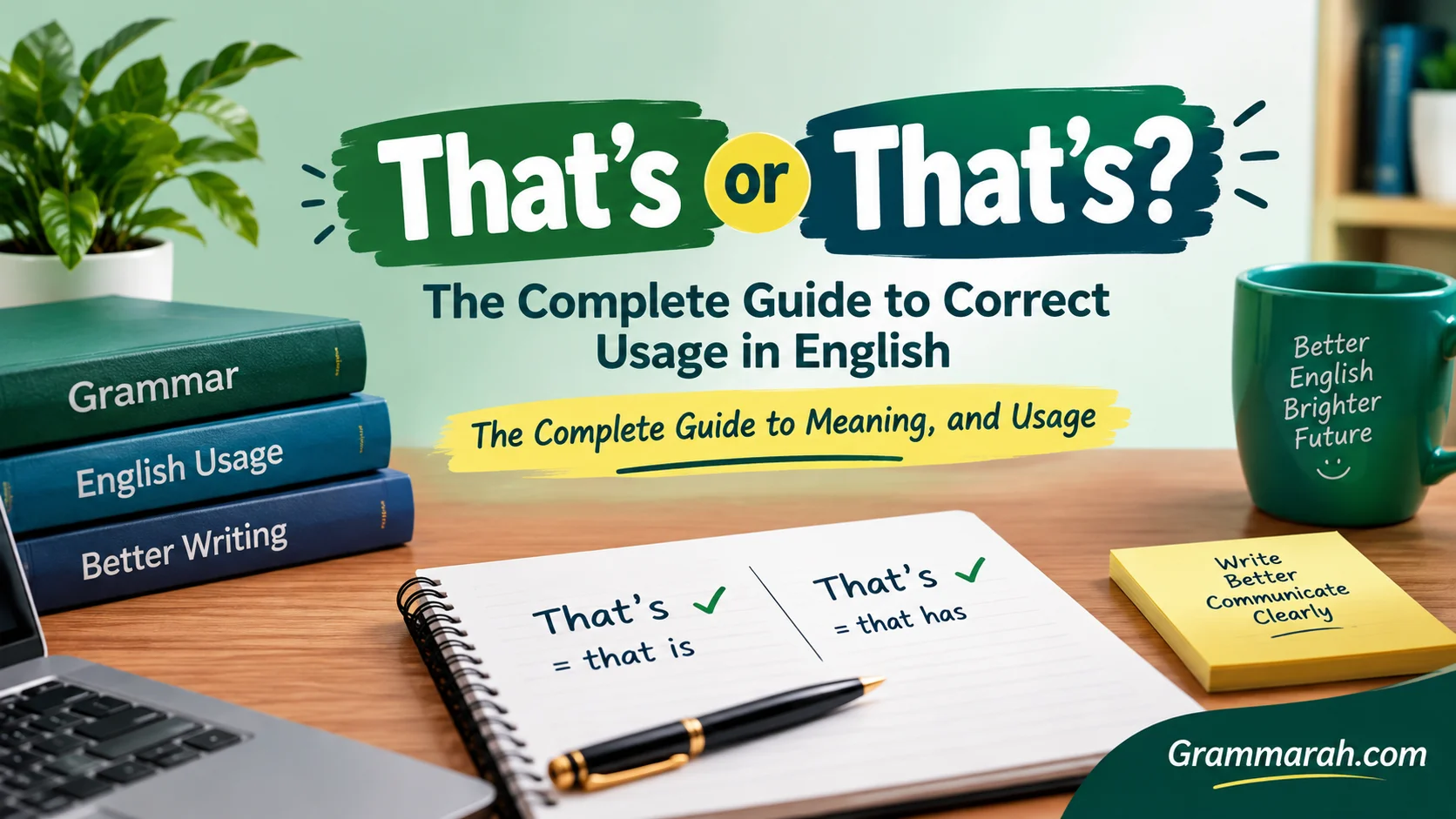

That or That can look almost the same, but the apostrophe creates an important grammatical difference in standard English usage. When you mean “that is” or “that has,” that’s is the correct contraction, while that is normally an incorrect spelling. This small punctuation mark helps readers recognize the intended meaning and keeps your writing clear, accurate, and professional.
The easiest way to remember the rule is to connect the word with its context and sentence meaning. That works when the shortened form of that is or that has makes sense. The form that, without the apostrophe, doesn’t follow standard English. You may see this mistake in emails, captions, comments, text messages, blog posts, and social media posts, especially when someone is typing quickly. During proofreading and editing, checking this tiny mark can prevent a grammatical error, spelling error, or careless appearance.
This distinction also matters in formal writing, informal writing, professional communication, and digital communication. The apostrophe rule supports grammatical correctness, grammatical accuracy, and clear written communication. When the apostrophe disappears, the word may still sound the same, but the written form becomes incorrect when you intend the contraction. Paying attention to apostrophe usage, sentence structure, word choice, meaning, and context makes the correct form easier to recognize and remember.
Quick Answer: That’s or That’s?
That’s correct when it means “that is” or “that has.”
That is generally incorrect when you’re trying to write that contraction.
| Form | Standard Use | Meaning | Example |
| that’s | ✅ Correct | that is | That’s a great idea. |
| that’s | ✅ Correct | that has | That’s happened before. |
| thats | ❌ Usually incorrect | Not the standard contraction | That’s a great idea. |
| that is | ✅ Correct | Full form | That is a great idea. |
| that has | ✅ Correct | Full form | That has happened before. |
The quickest way to check is the replacement test. Replace that with that is. If that doesn’t fit, try that has.
For example:
That’s my book.
→ That is my book. ✅
But:
That’s happened before.
→ That has happened before. ✅
Once you learn this trick, the choice becomes much easier.
What Does “That’s” Mean?
That’s a contraction. It combines that with either is or has.
A contraction is a shortened form created by combining words. The apostrophe shows that part of the original form has been omitted.
For example:
- I’m = I am
- you’re = you are
- don’t = do not
- can’t = cannot
- she’s = she is or she has
- that’s = that is or that has
The apostrophe therefore has a real grammatical purpose. It isn’t simply decoration or optional punctuation.
Consider these examples:
- That’s my car. → That is my car.
- That’s difficult. → That is difficult.
- That’s happened before. → That has happened before.
- That’s been a problem. → That has been a problem.
The meaning depends on the grammar of the sentence.
Why Does the Apostrophe Matter?
Think of the apostrophe as a tiny sign telling the reader, “This word has been shortened.”
In that’s, the apostrophe connects the shortened form to its original words.
Compare:
That’s the answer. ✅
with:
That’s the answer. ❌
The first follows standard contraction rules. The second normally looks like a typing or spelling mistake.
That distinction matters even though most readers will understand the intended meaning.
When “That’s” Means “That Is”
The most common meaning of that is “that is.”
You’ll see this use everywhere in everyday English. It appears in conversation, emails, articles, messages, workplace communication, and countless ordinary sentences.
How “That’s” Works as “That Is”
When that means that is, you can normally expand it without changing the basic meaning.
For example:
- That’s important. → That is important.
- That’s my brother. → That is my brother.
- That’s the problem. → That is the problem.
- That’s unusual. → That is unusual.
- That’s in the garage. → That is in the garage.
The contraction simply makes the sentence shorter and more natural.
Examples of “That’s” Meaning “That Is”
Before an adjective:
- That’s amazing.
- That’s expensive.
- That’s strange.
- That’s impossible.
Before a noun:
- That’s my phone.
- That’s the answer.
- That’s her office.
- That’s the main issue.
Before a prepositional phrase:
- That’s on the table.
- That’s in the kitchen.
- That’s near the entrance.
Before a present progressive construction:
- That’s working well.
- That’s causing the problem.
- That’s changing rapidly.
In each example, you can replace that’s with that is.
Spoken English vs. Written English
Contractions are especially common in spoken English because they help speech move naturally.
Compare:
That’s what I wanted to tell you.
with:
That is what I wanted to tell you.
Both sentences are grammatically correct. The first sounds more relaxed and conversational. The second can sound more deliberate or emphatic.
That’s why that often feels more natural in ordinary conversation.
However, using the full form doesn’t automatically make a sentence better. The right choice depends on your purpose and tone.
When “That’s” Means “That Has”
Here’s the part that sometimes catches learners off guard.
That can also mean “that has.”
For example:
That’s happened before.
This means:
That has happened before.
The contraction is exactly the same. Only the meaning changes.
The Structure of “That’s” as “That Has”
When that means that has, has usually works as an auxiliary verb in a perfect construction.
Look at these examples:
- That’s happened before. → That has happened before.
- That’s changed everything. → That has changed everything.
- That’s been difficult. → That has been difficult.
- That’s caused several problems. → That has caused several problems.
- That’s started a new discussion. → That has started a new discussion.
Words such as been, happened, changed, caused, and started can provide useful clues.
The important point is that that’s doesn’t have a single fixed meaning. The surrounding grammar tells you whether ’s represents is or has.
Examples of “That’s” Meaning “That Has”
Consider:
That’s been a difficult decision.
Expand it:
That has been a difficult decision.
Now:
That’s happened more than once.
Expand it:
That has happened more than once.
And:
That’s changed the way we work.
becomes:
That has changed the way we work.
The apostrophe remains in every case because you’re still using a contraction.
How to Tell Whether “That’s” Means “That Is” or “That Has”
You don’t have to rely on instinct.
Use the Replacement Test
When you see that, expand it.
First, try that.
If the sentence works, you’ve found the meaning.
If it doesn’t, try that.
For example:
That’s a beautiful painting.
Try:
That is a beautiful painting.
It works.
Therefore:
That’s = that is
Now consider:
That’s happened several times.
Try:
That has happened several times.
That doesn’t work.
Try:
That has happened several times.
Now the sentence works.
Therefore:
That’s = that has
A Simple Decision Table
| Original sentence | Expanded form | Meaning |
| That’s interesting. | That is interesting. | That is |
| That’s my jacket. | That is my jacket. | That is |
| That’s the problem. | That is the problem. | That is |
| That’s happening now. | That is happening now. | That is |
| That’s happened before. | That has happened before. | That has |
| That’s been difficult. | That has been difficult. | That has |
| That’s changed recently. | That has changed recently. | That has |
The key is context. The apostrophe tells you that a contraction exists, but the surrounding words tell you which verb has been shortened.
Why “Thats” Is Usually Wrong
The form that looks tempting because the pronunciation doesn’t contain an obvious pause.
When people say that, the words flow together naturally. While typing, it’s easy to reproduce the sound without remembering the apostrophe.
But standard written English requires the apostrophe for this contraction.
The correct formation is:
that + is → that’s
or:
that + has → that’s
The apostrophe marks the contraction.
The Apostrophe Is Part of the Standard Spelling
Look at these familiar pairs:
| Correct contraction | Incorrect missing-apostrophe form |
| that’s | thats |
| don’t | dont |
| can’t | cant |
| they’re | they’re |
| we’re | were |
| you’re | you’re |
There’s an important lesson here.
A contraction isn’t simply a shorter spelling. It has a conventional written form. Removing the apostrophe can create a different word or an incorrect form.
For instance, cant can appear as a separate English word in specialized contexts, while can’t means cannot. Likewise, were is already a standard word, so we need its apostrophe to show the contraction.
Why Autocorrect May Not Fix “Thats”
Autocorrect can help, but it isn’t a perfect grammar editor.
Writing software may miss a missing apostrophe, especially when the surrounding sentence remains easy to understand.
The mistake often appears during:
- Fast typing
- Phone messaging
- Social media posts
- Informal notes
- Quick emails
- Long writing sessions
That’s why proofreading still matters.
A useful habit is to search your finished writing for common contraction mistakes. Don’t assume a spellchecker will catch every punctuation problem.
Can “That’s” Ever Be Correct?
There’s one important distinction.
That isn’t the standard contraction of that is or that has. However, a sequence of letters can appear in a proper name, title, username, brand name, or deliberately stylized expression.
If an organization officially chooses a particular spelling, that spelling belongs to the name.
Proper Names and Brand Names
Imagine a fictional company called:
Thats Example
If that is the company’s official name, you would preserve its spelling when referring to the company.
That doesn’t mean that has become a standard English contraction.
Compare the two situations:
That’s a useful tool.
Here, that’s = that is.
But:
Thats Example
could be a proper name if an organization deliberately uses that spelling.
The distinction is simple:
A name can have an unusual spelling without changing the rules of ordinary English grammar.
Don’t Treat Brand Styling as a Grammar Rule
Brand names often use unusual capitalization, punctuation, spacing, or spelling.
That’s part of branding.
If a company chooses Thats as its name, the spelling belongs to the company. It doesn’t give writers permission to remove the apostrophe from ordinary sentences.
So don’t use a brand’s styling as evidence that that is a standard alternative to that.
Common Misconceptions About “That’s” and “Thats”
The mistake usually comes from a small misunderstanding rather than a lack of English knowledge.
Misconception: Apostrophes Are Optional
They aren’t optional in standard contractions.
The apostrophe shows that letters have been omitted.
For example:
- I’m = I am
- you’re = you are
- they’re = they are
- we’ve = we have
- that’s = that is or that has
If you remove the apostrophe, you remove an important part of the conventional spelling.
Misconception: Texting Rules Apply Everywhere
Informal digital communication often ignores punctuation.
You might receive a message saying:
thats fine
The meaning is obvious. Nobody needs to ask what the writer meant.
Still, informal texting habits don’t automatically become standard written English.
If you’re writing an article, application, school assignment, business email, or professional document, use:
That’s fine.
The difference isn’t about whether the reader understands you. It’s about whether your writing follows standard conventions.
Misconception: The Apostrophe Shows Possession
An apostrophe can indicate possession:
Sarah’s book
But the apostrophe in that has a different function.
It marks a contraction.
So:
That’s = that is / that has
It does not mean that something belongs to “that.”
This distinction becomes especially useful when you study confusing pairs such as it’s and its.
Conclusion
Understanding That’s or That’s is simple once you remember the role of the apostrophe. That is the correct contraction of “that is” or “that has,” while that is generally incorrect when you intend that contraction. A quick proofreading check can help you catch this small grammar mistake and keep your writing clear, accurate, and professional.
FAQs
Q1. Is “that’s” or “that’s” correct?
That’s correct when you mean “that is” or “that has.” That is incorrect when used as the contraction.
Q2. What does “that’s” mean?
That can mean “that is” or “that has.” The surrounding context tells you which meaning applies.
Q3. Why does “that’s” have an apostrophe?
The apostrophe shows that letters have been omitted from the longer expression. It turns “that is” or “that has” into “that’s.”
Q4. Can I use “thats” in formal writing?
No. In standard English, use “that’s” when you mean “that is” or “that has.” Writing “thats” without the apostrophe is normally a spelling or punctuation error.
Q5. Is “that’s” always a contraction?
In standard usage, that’s is a contraction of “that is” or “that has.” For example, “That’s correct” means “That is correct.”