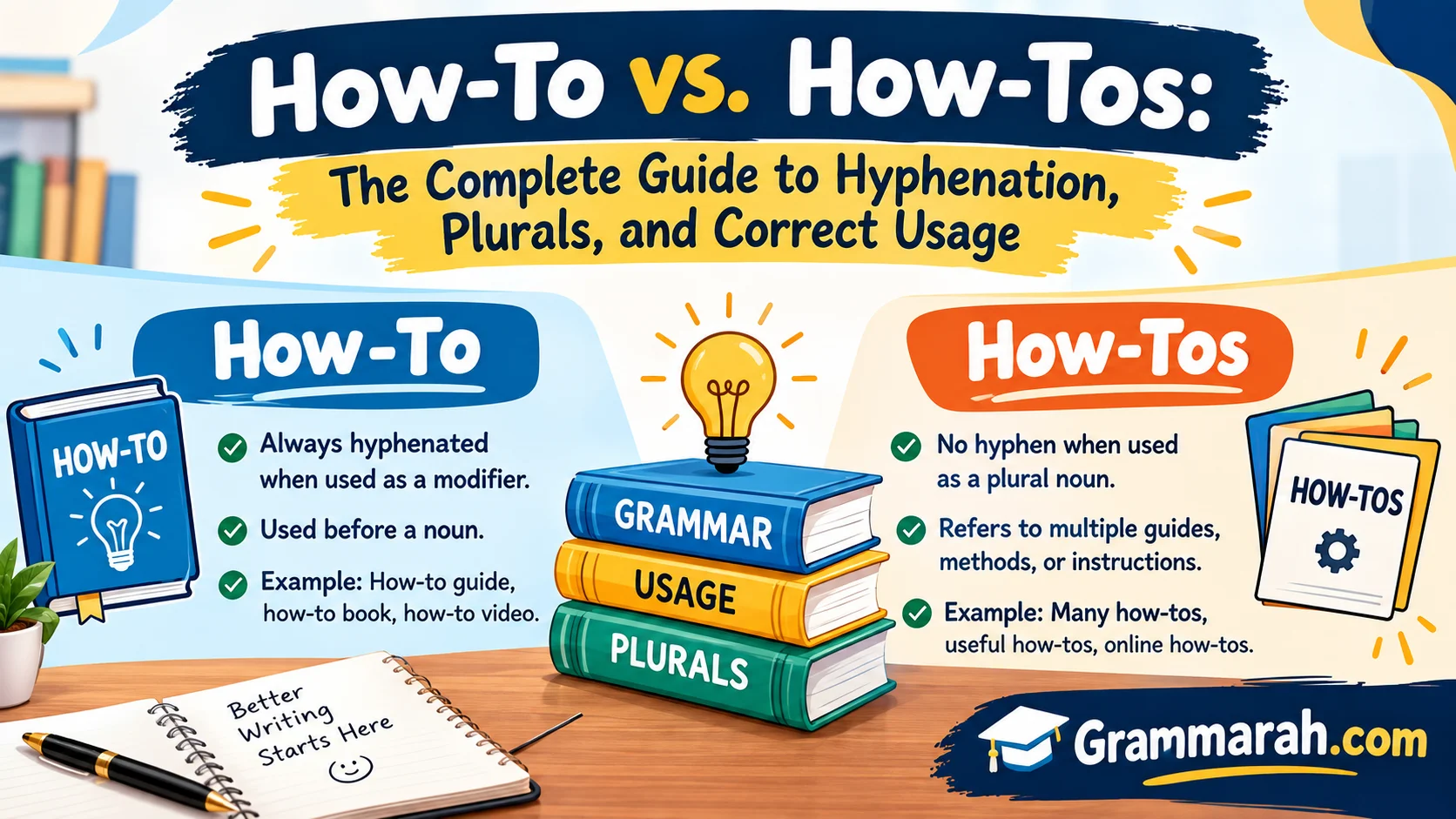

How-To vs. How-Tos can seem confusing because the tiny hyphen changes the meaning and grammatical role of the phrase. How-to can work as a noun meaning an instructional guide, while how-tos is the plural form used for multiple instructional guides. For example, a website might publish several how-tos about cooking, writing, or home repairs. In a content category or headline, “How-Tos” can clearly signal that readers will find several practical guides in one place.
The form also changes when how-to modifies another noun. In “how-to guide,” the phrase acts as a modifier rather than naming the guide by itself. This gives how-to a different grammatical job within the sentence. You may also see it before terms such as instructional content, where the phrase describes the type of material being offered. Understanding this grammatical construction helps you avoid mixing the singular and plural forms when creating a headline, label, or content category.
The biggest distinction appears when you compare these forms with how to. In a sentence such as “learn how to cook,” the words introduce a verb construction rather than functioning as a noun. That’s why you shouldn’t automatically add a hyphen whenever you see the words “how to.” A simple rule works well: use how-to for a guide or as a modifier, how-tos for multiple guides, and how to when the phrase forms part of a grammatical construction. This small distinction makes your writing clearer and prevents an easy grammatical mistake.
Quick Answer: Is It “How-To,” “How-Tos,” vs “How To’s”?
If you’re talking about an instructional guide, use how-to for the singular and how-tos for the plural.
If you’re using how to as part of a sentence that explains an action, keep it open:
- Correct: I learned how to bake bread.
- Correct: I found a useful how-to about baking bread.
- Correct: The website publishes several how-tos.
- Correct: She wrote a how-to guide for beginners.
- Generally avoid: The website publishes several how to’s.
The simplest rule is this:
how to = a grammatical phrase
how-to = an instructional noun or modifier
how-tos = the plural noun
That distinction solves most how-to vs. how-tos questions before they become a punctuation headache.
What Does “How-To” Mean?
At its core, how-to refers to practical instruction. It can describe material that teaches someone how to perform a task, understand a process, or accomplish a particular goal.
As a noun, how-to can refer to an instructional resource. As a modifier, it describes something designed to provide practical instructions.
That dual role explains why you see the hyphen in several different settings.
“How-To” as a Noun
When how-to stands alone as a noun, it refers to an instructional resource or practical explanation.
Consider these examples:
- I found a helpful how-to on repairing a leaky faucet.
- The magazine published a detailed how-to on growing tomatoes.
- She watched a how-to before installing the shelves.
- The site has hundreds of useful how-tos.
Here, how-to names a thing. It’s not telling you how to perform an action inside the sentence. It’s naming the instructional material itself.
“How-To” as a Noun Modifier
How-to can also appear directly before another noun to describe its purpose.
For example:
- how-to guide
- how-to article
- how-to video
- how-to manual
- how-to book
- how-to workshop
- how-to tutorial
In how-to guides, the phrase tells you what kind of guide you’re looking at. The hyphen ties the words together as a compound modifier.
“How to” as a Grammatical Construction
Here’s where the confusion usually starts.
In a sentence such as:
She learned how to use the new software.
How to isn’t a noun meaning an instructional guide. Instead, it forms part of an infinitive construction. The phrase tells us the method or action she learned.
More examples:
- I don’t know how to fix this.
- He showed me how to open the file.
- They explained how to apply the formula.
- Can you teach me how to use the machine?
So don’t automatically hyphenate every occurrence of how to. The grammar determines the spelling.
When Should You Write “How-To” With a Hyphen?
The hyphen becomes useful when how-to operates as a compound noun or compound modifier. Don’t treat every how to as the same grammatical unit.
| Usage | Preferred Form | Example |
| Instructional noun | how-to | I found a useful how-to. |
| Plural instructional noun | how-tos | I read several how-tos. |
| Compound modifier | how-to | She wrote a how-to guide. |
| Infinitive construction | how to | She learned how to write. |
Use “How-To” as a Noun
When the phrase itself names an instructional resource, use how-to.
For example:
Singular: This how-to explains the process.
Plural: These how-tos explain different techniques.
The noun behaves like an ordinary lexical item. You can put an article before it, pluralize it, or use it as the subject or object of a sentence.
Use “How-To” Before Another Noun
When how-to modifies a following noun, the hyphen makes the relationship clear:
- how-to guide
- how-to manual
- how-to article
- how-to video
For example:
The editor requested a new how-to article about password security.
The phrase isn’t describing the act of learning how to article. Instead, how-to tells readers what type of article it is.
Keep “How to” Open in Ordinary Sentences
When introducing an action, don’t insert a hyphen.
Write:
- Learn how to write better headlines.
- I’ll show you how to change the settings.
- She knows how to solve the problem.
- We need to explain how to use the tool.
The meaning is different from the noun how-to.
A useful test is to replace how-to with guide. If the substitution works, you’re probably dealing with the noun:
I found a useful how-to.
I found a useful guide.
But:
I learned how to swim.
You can’t replace how to with guide. You’re dealing with a grammatical phrase.
The Plural Problem: “How-Tos” vs. “How To’s”
Once how-to becomes a noun, writers often stumble over the plural. The straightforward form is how-tos.
The basic pattern is:
how-to → how-tos
Not:
how-to → how to’s
And not:
how-to → how-tos’
The last form requires a possessive meaning rather than an ordinary plural.
Why “How-Tos” Is the Preferred Plural
The plural ending attaches to the noun itself. You simply add -s to the end of the compound:
- one how-to
- two how-tos
- several how-tos
- hundreds of how-tos
This follows the normal behavior of many compound nouns.
| Singular | Plural |
| check-in | check-ins |
| follow-up | follow-ups |
| break-in | break-ins |
| how-to | how-tos |
The spelling may look unusual because to normally appears as a separate grammatical word. Once the compound noun how-to has been established, however, the plural simply goes at the end.
Why “How-Tos” Looks Strange at First
There’s a visual problem here. How-tos can momentarily make readers wonder whether tos is a word.
That’s probably one reason how to’s appears in informal writing. The apostrophe creates a visual pause that can seem more familiar.
However, visual familiarity isn’t the same as grammatical necessity. When you’re referring to multiple instructional guides, how-tos is the cleaner choice.
Why “How To’s” Creates Confusion
The apostrophe in how to’s is doing work it doesn’t need to do.
In ordinary English, apostrophes primarily indicate possession or contractions. They don’t normally create regular plurals.
For example:
- the writer’s guide = possession
- don’t = contraction
- writers = plural
- guides = plural
- how-tos = plural
That’s why how to’s is generally not the preferred spelling when you simply mean multiple instructional guides.
Incorrect vs. Correct Examples
| Less Preferred | Preferred |
| We published five how-to’s. | We published five how-tos. |
| The site contains useful how-to’s. | The site contains useful how-tos. |
| Read our latest how to’s. | Read our latest how-tos. |
| I collected several how-to’s. | I collected several how-tos. |
The important point is simple: don’t use an apostrophe merely to form this plural.
“How-To” vs. “How To”: Why the Hyphen Matters
A hyphen isn’t a decoration. It can signal how readers should group words.
Compare:
She wrote a how-to guide.
with:
She explained how to write a guide.
The first sentence names a type of guide. The second describes an action.
That’s a meaningful grammatical difference.
A Simple Test You Can Use
When you’re unsure, ask yourself:
Am I naming an instructional resource?
If yes, use how-to.
This how-to explains basic photography.
Am I explaining the method for doing something?
If yes, use how to.
This article explains how to use a camera.
That one question resolves a surprising number of usage problems.
Common “How-To” vs “How-Tos” Mistakes
Small punctuation choices can create surprisingly large inconsistencies across a website. These are the mistakes worth watching.
Mistake #1: Treating “How To” as a Noun
A writer may say:
I found a great website online.
For standard edited prose, how-to is clearer when the phrase functions as the noun:
I found a great how-to online.
The hyphen tells the reader that the phrase operates as a single lexical unit.
Mistake #2: Adding an Apostrophe to the Plural
This is probably the most common plural problem:
We have 50 ways to’s.
Prefer:
We have 50 how-tos.
The apostrophe isn’t required merely because the noun contains the word to.
Mistake #3: Hyphenating Every “How To”
This mistake goes in the opposite direction.
Don’t write:
I learned how-to bake bread.
Write:
I learned how to bake bread.
The first version incorrectly treats the grammatical construction as the noun how-to.
Mistake #4: Dropping the Hyphen in a Compound Modifier
You may encounter:
a how to guide
In careful writing, how-to guides make the compound relationship much clearer.
Mistake #5: Assuming Every Style Guide Handles It Identically
Language style can be messier than a simple right-or-wrong chart suggests. Editorial traditions sometimes differ, especially around unusual compounds, capitalization, and punctuation.
For general American English, how-to and how-tos are the safest forms for the instructional noun. If you’re writing for a specific publication, follow its house style when it differs.
How “How-To” Works in Titles, Headings, vs Digital Content
The word how-to is especially common in publishing because instructional content is everywhere.
Websites publish:
- how-to articles
- how-to guides
- how-to videos
- how-to tutorials
- how-to manuals
- how-to resources
The phrase also works naturally in headlines:
How-To Guide: How to Build a Raised Garden Bed
Here, the first How-To describes the type of guide. The second How to introduce the actual action being explained.
That’s a perfect example of why these forms shouldn’t be treated as interchangeable.
“How-Tos” as a Content Category
Suppose a website has a library containing dozens of instructional articles.
You might write:
Browse our collection of how-tos.
Here, how-tos functions as a plural noun.
You could also avoid the unusual-looking plural entirely:
Browse our collection of guides.
Both can work. The better choice depends on the site’s tone and audience.
Search-Friendly Writing Without Changing the Grammar
Search-friendly writing doesn’t give you a free pass to ignore standard usage.
If your target keyword is how-to vs. how-tos, you can naturally use that phrase in the title, headings, introduction, and relevant sections. But forcing awkward variants throughout the article can make the copy harder to read.
Useful related searches include:
- how-to vs. how-tos
- how-to or how to
- how-tos or how to’s
- how-to plural
- how-to guide
- how to use how-to
- how to pluralize how-to
The goal isn’t to repeat one phrase mechanically. It’s to answer the real questions readers have.
Conclusion
Understanding how-to, how-tos, and how to become much easier once you look at their grammatical roles. Use how-to for a single instructional guide or as a modifier, how-tos for multiple guides, and how to when it forms part of a regular sentence. The hyphen isn’t just decoration; it helps show how the phrase functions.
FAQs
Q1. Is “how-to” one word or two words?
How-to is normally hyphenated when it works as a noun for an instructional guide or as a modifier, such as “how-to guide.”
Q2. Is “how-tos” the correct plural of “how-to”?
Yes. How-tos is the standard plural form when you mean multiple instructional guides.
Q3. Should I write “how to” or “how-to”?
Use how to when it introduces a verb phrase, such as “learn how to cook.” Use how-to when it functions as a noun or modifier.
Q4. Is “how to’s” correct?
Generally, no. How-tos is preferred because the plural is formed with -s, not an apostrophe.
Q5. What is the difference between “how-to” and “how-tos”?
How-to usually refers to one guide, while how-tos refers to multiple guides. The distinction is mainly singular versus plural usage.