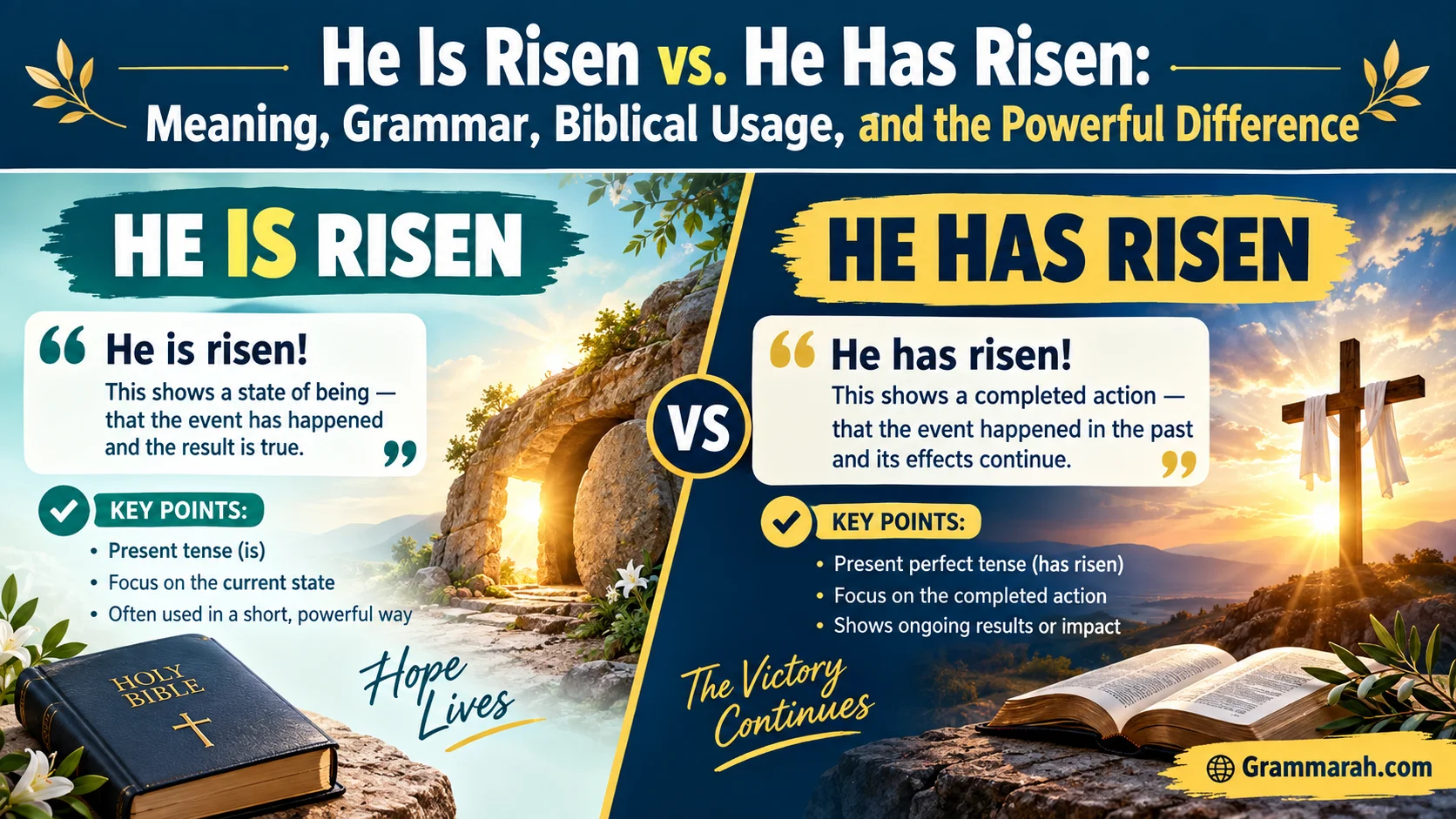

In He Is Risen vs. He Has Risen, both expressions share the same Christian message, but their grammar and tone differ slightly. Both refer to the resurrection, yet they reflect different patterns of English usage. He is raised sounds traditional, familiar, and solemn, which explains its strong connection with Christians, generations of Easter worship, and older Bible translations. He has risen, however, follows the ordinary present-perfect pattern of contemporary English, putting clearer focus on the completed action of rising.
The two forms don’t express different beliefs or change the central claim. Instead, they can place different emphasis on state, action, tradition, and present significance. This distinction becomes easier to see through major Bible translations. The King James Version uses He is risen in Matthew 28:6, while the ESV, NIV, and NASB use He has risen. The difference reflects changing grammatical preferences rather than a different theological meaning.
When choosing the right phrase, consider your purpose, audience, and message. He is risen works naturally in Easter sermons, hymns, and theological discussions, where historical layers, theological layers, and emotional weight matter. He has risen often fits modern writers, everyday conversation, and explanatory writing because it sounds more natural in current English. Understanding these grammatical layers, historical influences, and theological context helps you recognize why both forms can be correct without treating either one as simply wrong.
Quick Answer: He Is Risen vs He Has Risen?
“He has risen” is the more natural choice in modern American English. It uses the present perfect: has + risen. The phrase describes a completed action while connecting that event with the present.
“He is risen” is a traditional religious expression. It uses an older English pattern in which it could function as an auxiliary with certain verbs. The wording survives especially in Christian and liturgical language.
| Phrase | Grammar | Modern feel | Typical emphasis |
| He is risen | is + risen | Traditional, solemn | Present risen state |
| He has risen | has + risen | Modern, natural | Completed action with present relevance |
| He rose | Simple past | Modern, direct | Past event |
So, if you’re writing ordinary modern English, “He has risen” is usually the clearest choice. If you’re using traditional Easter language, quoting a traditional Bible translation, or deliberately preserving religious wording, “He is risen” remains completely recognizable and meaningful.
He Is Risen: What Does the Phrase Actually Mean?
At its simplest, “He is risen” means that Jesus has been raised from death and now lives in a risen state. The phrase doesn’t merely point backward to the resurrection. Its traditional wording also allows the listener to focus on the reality that Christ is now risen.
That helps explain why the expression has such staying power. It functions almost like a proclamation rather than an ordinary report. Compare the difference in feel between “He has risen” and “He is risen.” The first sounds like someone reporting what happened. The second sounds like someone declaring a reality.
Grammatically, however, “is risen” can look strange to a modern reader. Most contemporary speakers expect have/has + past participle when describing a completed event with present relevance. We say:
- She has arrived.
- The train has left.
- He has returned.
- He has risen.
That pattern feels completely ordinary. “He is risen” does not.
Why “Is Risen” Sounds Unusual Today
The difference comes partly from the history of English auxiliary verbs. Modern English overwhelmingly uses have to form the perfect. Historical English, however, also used be with certain intransitive verbs, particularly verbs associated with movement or a change of state.
Historical-linguistic research shows that English gradually shifted away from be as a perfect auxiliary. Older be-perfect constructions became much less common as English developed, leaving have as the normal auxiliary in modern English.
That historical change matters because “He is risen” wasn’t simply invented as an incorrect version of “He has risen.” It reflects an older grammatical tradition that survived in religious language after everyday English had largely moved in another direction.
He Has Risen: The Modern English Form
“He has risen” follows the standard present-perfect construction in contemporary English:
He + has + risen
Here, has is the auxiliary verb and risen is the past participle of rise.
The verb itself has three important forms:
| Form | Example |
| Present | He rises |
| Simple past | He rose |
| Past participle | He has risen |
This distinction prevents a common mistake. “He rose” and “He has risen” aren’t interchangeable in every context. The first uses the simple past. The second uses the present perfect.
Why “He Has Risen” Sounds Natural Today
Modern English speakers encounter the has + past participle pattern constantly. That’s why “He has risen” doesn’t require special interpretation.
The present perfect can describe an action that occurred in the past while keeping its result or relevance connected to the present. Consider:
- The guest has arrived.
- The snow has melted.
- The company has expanded.
- He has risen.
The event happened. Its consequences or present relevance remain important.
That makes “He has risen” particularly well suited to a resurrection statement. The resurrection is understood as a completed event, yet its significance isn’t confined to the past.
He Is Risen vs. He Has Risen: The Core Grammar Difference
The easiest way to understand the distinction is to separate grammar from religious interpretation.
“He has risen” uses the present perfect tense. It presents the rising as an accomplished event with relevance now.
“He is risen” uses is + risen, a form associated with older English usage and preserved in traditional religious language. Modern readers can naturally understand it as emphasizing the resulting state: he is now risen.
That doesn’t mean the phrases teach opposite theological ideas. Far from it.
The grammatical difference is real, but the theological difference is often overstated.
State vs. Completed Action
A useful way to visualize the distinction is this:
He has risen → event → present significance
He is risen → present state → proclamation
The first construction draws attention to what happened. The second can draw attention to what is true now.
That distinction is subtle rather than absolute. Context controls how strongly readers perceive it.
For example, if someone says “He has risen from the dead,” the sentence naturally highlights the resurrection event. If someone says “He is risen,” the short declaration can sound more like an announcement of present reality.
Biblical Evidence: What Do Major Bible Translations Say?
This is where the discussion becomes especially useful because the English Bible itself provides evidence for both forms.
Matthew 28:6 offers a particularly clear comparison. The King James Version reads “he is risen,” while the English Standard Version, New International Version, and New American Standard Bible use “he has risen.”
Mark 16:6 shows the same translation difference. The KJV gives “he is risen,” while the ESV, NIV, and NASB use “he has risen.”
Luke 24:6 provides another striking example. The KJV says “is risen,” whereas the ESV, NIV, and NASB use “has risen.”
Bible Translation Comparison
| Passage | KJV | ESV | NIV |
| Matthew 28:6 | He is risen | He has risen | He has risen |
| Mark 16:6 | He is risen | He has risen | He has risen |
| Luke 24:6 | He is risen | He has risen | He has risen |
This comparison makes one point very clear: “He is risen” isn’t simply a modern grammar error that slipped into religious writing. It is an established translation language, especially associated with older English Bible tradition.
At the same time, modern translations aren’t being careless when they use “he has risen.” They’re reflecting contemporary English grammar and style.
Why Religious Tradition Preserved “He Is Risen”
Religious language has a remarkable memory.
Everyday speech changes quickly. Worship language often doesn’t. Once a phrase becomes deeply associated with prayers, hymns, sermons, Easter services, and familiar scripture, people continue repeating it long after ordinary speech has changed.
That’s exactly what happened with “He is risen.”
The phrase became part of a larger Christian vocabulary surrounding Easter. Its brevity also gives it rhetorical power. Three words can carry an enormous amount of meaning.
He is risen.
No explanation is needed for an audience that already knows the story. The wording works almost like a verbal banner.
The Power of Traditional Wording
Traditional expressions often survive because people don’t encounter them as ordinary grammar lessons. They encounter them as part of meaningful rituals and repeated experiences.
A person may hear “He is risen” in church every Easter, see it printed on a program, encounter it in a hymn, or hear a minister proclaim it. Repetition gives the phrase cultural weight.
This doesn’t make it the most common form in modern English. It makes it traditional.
That’s an important distinction.
Historical English and the Rise of “Has”
The shift from “is risen” toward “has risen” fits a much broader development in English grammar.
Historical research describes a long-term movement which has become the dominant auxiliary for English perfect constructions. Earlier English allowed more variation, but the be-perfect gradually declined.
So modern speakers aren’t merely choosing a different phrase because it sounds fashionable. They’re participating in a larger grammatical development.
You can see the same principle in ordinary language:
- Older-style: He has arrived.
- Modern: He has arrived.
- Older-style: They are departed.
- Modern: They have departed.
The modern forms are much more familiar to most American English speakers.
“He has risen” belongs to that modern pattern.
Does “He Is Risen” Mean Something More Theological?
This question deserves a careful answer.
Some readers hear “He is risen” as emphasizing Christ’s current condition. That interpretation is understandable because the wording places it directly before rising.
However, grammar alone doesn’t establish a complete theological doctrine.
It would be too strong to claim that “He is risen” teaches one theology while “He has risen” teaches another. Both expressions can proclaim the resurrection of Jesus.
The more defensible distinction concerns emphasis.
“He Is Risen” and Present Reality
The traditional form can sound like a declaration of present reality:
He is risen now.
That quality helps explain its strength as an Easter proclamation. The statement doesn’t feel like a detached history lesson. It feels immediate.
“He Has Risen” and the Completed Resurrection
The present perfect naturally places the resurrection in the category of a completed event with continuing relevance.
The structure resembles statements such as:
- The work has finished.
- The guest has arrived.
- The king has returned.
The action happened, yet the result matters now.
For Christian readers, that combination fits naturally with the resurrection message. The resurrection occurred in the past, but its significance is understood as continuing into the present.
He Rose vs. He Has Risen vs. He Is Risen
These three expressions deserve separate attention because they often get mixed together.
He Rose
“He rose” uses the simple past tense.
It presents the resurrection as a past event:
He rose from the dead.
This form is grammatically straightforward and completely natural in modern English.
He Has Risen
“He has risen” uses the present perfect tense.
It presents the resurrection as completed while connecting it to the present:
He has risen from the dead.
This is the standard modern construction.
He Is Risen
“He is risen” uses an older construction that survives in traditional Christian language:
He is risen.
Modern readers understand it, but they may not produce this structure spontaneously in everyday speech.
When Should You Use “He Is Risen”?
Choose “He is risen” when traditional or liturgical language is part of the purpose.
It works especially well in:
- Easter greetings
- Church services
- Traditional Christian writing
- Religious artwork and messages
- Sermons using established Easter language
- Quotations from traditional Bible translations
- Historical or literary discussions
If the goal is to preserve a familiar Easter expression, changing it to “He has risen” may remove some of the traditional flavor.
That’s not a grammar problem. It’s a style and context decision.
When Should You Use “He Has Risen”?
Use “He has risen” when you want natural contemporary English.
It works especially well in:
- General explanatory writing
- Modern articles
- Educational material
- Contemporary Christian communication
- Modern Bible translations
- Everyday conversation
- Writing for a broad American English audience
If you’re unsure which form will sound natural to a modern reader, “He has risen” is usually the safer choice.
Conclusion
Understanding the difference between [topic] becomes much easier once you know how each form is used in context. Although the words or spellings may look similar, they can have different meanings, grammatical roles, or levels of standard usage. In most everyday and formal writing, choosing the correct form helps your sentences sound clear, natural, and professional. When in doubt, consider the meaning you want to express and the context in which you’re using the word.
FAQs
Q1. What is the main difference between these terms?
The main difference depends on their meaning, spelling, pronunciation, or grammatical function. Understanding the context will help you choose the correct form.
Q2. Which form is correct in standard English?
The standard English form is generally the safest choice for formal writing, academic work, professional communication, and edited content.
Q3. Can both forms be used in English?
Sometimes both forms exist, but they may differ in meaning, usage, regional preference, or level of formality. They shouldn’t automatically be treated as interchangeable.
Q4. How can I remember which form to use?
Focus on the meaning and context rather than spelling alone. Creating a simple example sentence for each form can also make the distinction easier to remember.
Q5. Which form should I use in formal writing?
Use the standard, widely accepted form that matches your intended meaning. This approach keeps your writing clear, polished, and easy to understand.