
The difference in Passerbyers vs Passersby vs Passerby becomes clearer when you understand the compound noun structure behind the word and its plural form. Passerby describes one person who passes by, while passersby describes two or more people. The passer part changes to passers, but remains unchanged. This standard plural pattern may seem unusual at first, yet it follows an established grammatical pattern in English. Writers sometimes add -s to the end and create passerbys, or add -ers and create passerbyers, but these forms don’t follow standard pluralization. For clear written English, knowing this small grammar rule helps you choose the correct word form without second-guessing your spelling.
You may also encounter passer-by and passers-by, which use a hyphenated spelling instead of the standard closed form. Both forms show the same basic grammatical relationship, although passerby and passersby are established spellings in current US English. This spelling variation reflects different conventions for writing a compound noun, rather than a difference in meaning. In everyday usage, formal writing, an article, report, email, news story, or formal document, the choice of spelling should stay consistent. The key grammatical detail is that the plural marker appears on passer, not at the end of the entire compound.
The same rule applies when you use the word in a sentence or another context. Passerby is the singular form for one person, whereas passersby is the plural form for several people who are passing or passing by. The suffix, ending, hyphen, and hyphenation affect how the word looks, but they don’t change its basic meaning, usage, or compound noun structure. From an NLP and lexical form perspective, these forms can appear closely related, but standard English distinguishes the correct form from an incorrect form. Understanding that distinction makes the word form, spelling, and standard usage much easier to handle in both casual and formal writing.
Quick Answer: Passerby vs Passersby vs Passerbyers
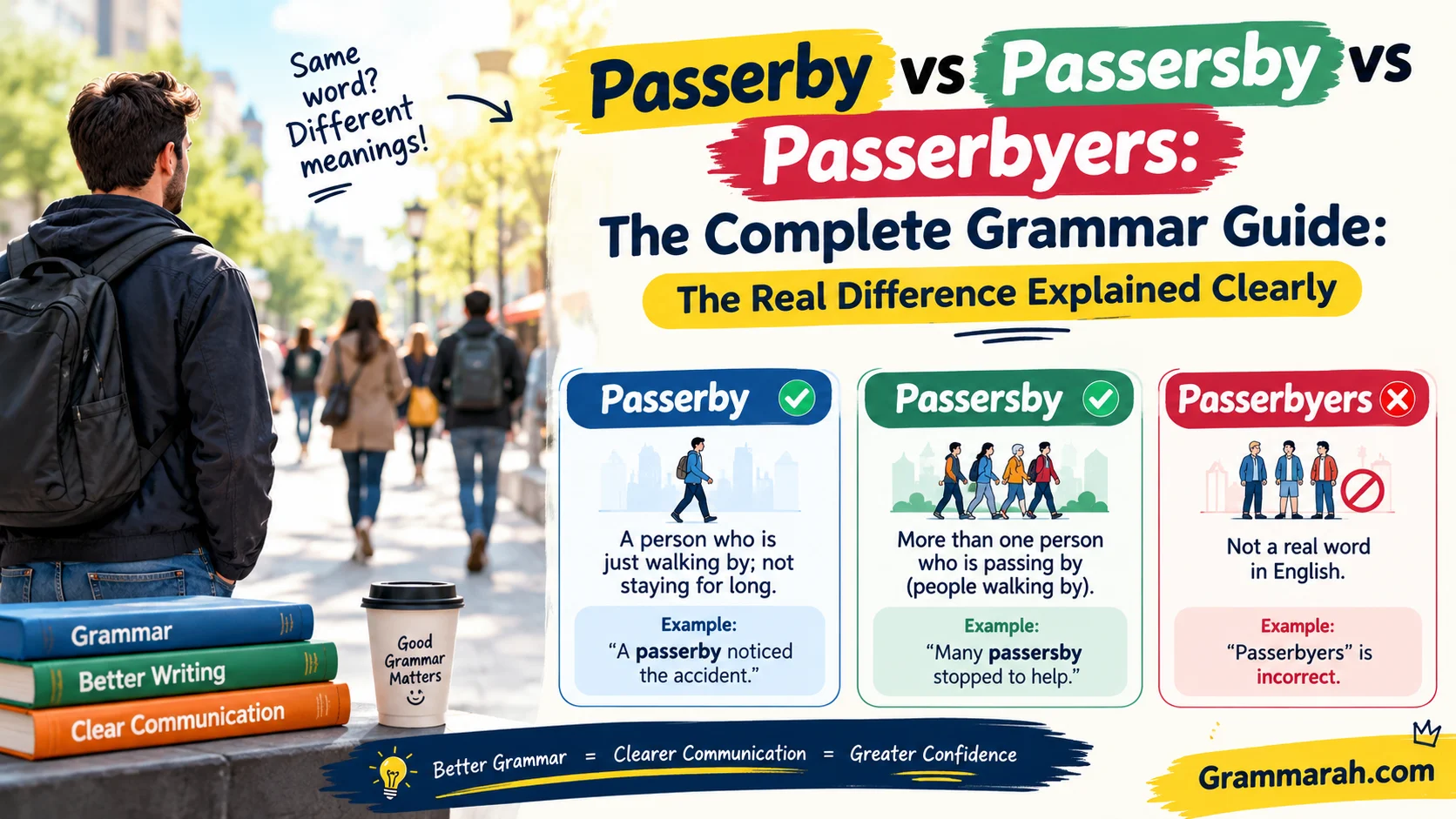
Passerby is the singular form. It means one person who happens to pass a particular place.
Passersby is the standard plural form. It means two or more people who pass by.
Passerbyers is not the standard plural of passerby. It adds an unnecessary -ers ending to an already established noun.
Passerbys is also not the standard plural form in edited English. The standard plural is passersby.
| Form | Number | Meaning | Standard Usage |
| passerby | Singular | One person passing by | Correct |
| passersby | Plural | Two or more people passing by | Correct |
| passer-by | Singular | One person passing by | Established variant |
| passers-by | Plural | Two or more people passing by | Established variant |
| passerbys | Plural | Intended to mean multiple people passing by | Avoid |
| passerbyers | Plural | Intended to mean multiple people passing by | Avoid |
The easiest rule is simple:
One passerby, two or more passersby.
What Does Passerby Mean?
A passerby is a person who is going past a particular place. The person doesn’t need to have any special connection with that location. They simply happen to be passing through.
For example:
- A passerby noticed smoke coming from the building.
- A passerby called the police after seeing the accident.
- The injured man asked a passerby for help.
- The passerby stopped to see what had happened.
The word often appears when someone’s presence becomes relevant to an event. A person may simply be walking down the street, but if that person sees an accident and calls emergency services, the person becomes an important passerby in the story.
The word can describe someone walking, driving, cycling, or otherwise moving past a location. The central idea is that the person is passing by.
Passerby in a Sentence
Because passerby is singular, it works with singular determiners and singular verb agreement.
For example:
- A passerby was standing near the entrance.
- The passerby saw the broken window.
- One passerby called for help.
- That passerby noticed the unusual activity.
Notice the verb in the first sentence: was, not were. The noun refers to one person.
You can also use passerby as an object:
- The police questioned a passerby.
- The photographer asked a passerby for directions.
- The child waved at the passerby.
The grammatical role can change, but the singular form stays the same.
Why Passerby Has an Unusual Plural
The confusion comes from the structure of the word.
Passerby combines passer with by. The first part, passer, refers to a person who passes. The second part, by, comes from the expression pass by and helps describe the person’s movement.
When English forms the plural, it doesn’t simply place -s at the very end of the complete word.
Instead, the plural marker attaches to passer:
passer + by → passerby
passers + by → passersby
That’s why passersby look unusual if you’re expecting every plural noun to end in -s.
Compare the structure:
- one passerby
- two passersby
- one passer-by
- two passers-by
The important change happens in passer, not in by.
This is similar to other compound nouns in English where the element that carries the main noun function receives the plural marker. However, compound nouns don’t all follow one universal rule, so it’s better to learn each established form rather than assume that every compound behaves identically.
Passerby: The Correct Singular Form
Use passerby when you’re talking about exactly one person.
Common singular patterns include:
- a passerby
- one passerby
- the passerby
- this passerby
- that passerby
- each passerby
- every passerby
For example:
A passerby noticed the fallen cyclist and stopped to help.
Here, a passerby clearly refers to one individual.
Another example shows how the word can appear in a more descriptive sentence:
The passerby looked through the window but didn’t enter the store.
Again, the sentence discusses one person.
Correct Singular Examples
Here are several natural examples:
- A passerby found the lost wallet.
- The passerby pointed toward the nearest station.
- One passerby heard the alarm and called emergency services.
- A curious passerby stopped to watch the street performance.
- The passerby gave the driver directions.
- Every passerby seemed to notice the unusual display.
The word doesn’t necessarily imply that the person stopped. A passerby can simply continue walking or traveling past the location.
Passersby: The Standard Plural Form
When you mean more than one person, use passersby.
This is the standard plural form in US English. The plural changes passer to passers, while by remains unchanged.
For example:
- Several passersby stopped to watch.
- Two passersby helped the injured cyclist.
- The police questioned several passersby.
- Curious passersby gathered outside the building.
- Many passersby ignored the noise.
The grammatical pattern becomes easier when you mentally separate the word into its two parts:
passer + by
Then pluralize the noun:
passers + by
That produces:
passersby
Why Passersby, Not Passerbys?
The form passerbys may look logical because many English nouns form plurals by adding -s at the end.
For example:
- book → books
- street → streets
- visitor → visitors
- passer → passers
But passerby isn’t being treated like a simple noun. It is an established compound noun.
The plural is therefore formed internally:
passerby → passersby
Not:
passerby → passerbys
And certainly not:
passerby → passerbyers
A useful way to remember the distinction is to think about what you’re actually pluralizing. You’re talking about multiple passers, not multiple boys.
Passerby vs Passersby Comparison Table
| Sentence | Correct? | Reason |
| A passerby called the police. | Yes | One person |
| Several passersby called the police. | Yes | Multiple people |
| Two passerbys called the police. | No | Standard plural is passersby |
| Several passerbyers called the police. | No | Passerbyers is not the standard plural |
| Every passerby noticed the sign. | Yes | Every takes singular |
| Many passersby noticed the sign. | Yes | Many takes plural |
Why Passerbyers Is Incorrect
Passerbyers look as though it might describe people who pass by. However, English doesn’t form the plural that way.
The problem becomes clearer when you examine the passer itself.
The word passer already identifies a person who passes. The -er ending helps create an agent noun from the verb pass. Adding another agentive ending to create passerby doesn’t produce the established English plural.
In other words, there is no grammatical need to turn:
passerby
into:
passerbyers
The established noun already exists. Its standard plural is passersby.
Consider these examples:
- Incorrect: Several passerbyers witnessed the accident.
- Correct: Several passersby witnessed the accident.
- Incorrect: The passerby gathered around the scene.
- Correct: The passersby gathered around the scene.
- Incorrect: Police asked the passerby what they had seen.
- Correct: Police asked the passersby what they had seen.
Why Passerbyers Can Sound Plausible
English speakers often create words by adding familiar endings. That’s one reason a form like passerby can seem understandable even though it isn’t the standard noun.
The brain recognizes:
pass + er = passer
Then it may mistakenly try to build another agent noun around the whole expression.
But English doesn’t need that extra construction. Passerby is already the noun.
This is an important distinction between a form being understandable and a form being standard. A reader can usually figure out what passerbyers means, but that doesn’t make it the accepted plural.
Is Passersby Ever Correct?
Passerbys is another tempting form.
At first glance, it follows a familiar pattern:
noun + s = plural
That pattern works for countless English nouns. Yet it doesn’t apply here.
The standard plural is:
passerby → passersby
not:
passerby → passerbys
This difference is especially important in edited writing. Nonstandard spellings can appear in casual online writing because people make mistakes, invent forms, or spell words according to sound. Their appearance doesn’t make them standard English.
For professional articles, reports, academic papers, business documents, or formal messages, use passersby
Conclusion
The difference between passerby, passersby, and passerbyers is easier to understand once you know how this compound noun forms its plural. Passerby refers to one person, while passersby refers to two or more people. The word passer changes to passers, while by remains unchanged. Passerbyers and passerbys are not standard plural forms. In modern US English, passerby and passersby are the forms you’ll normally want in clear, polished writing.
FAQs
Q1. Is passerby singular or plural?
Passerby is singular. It refers to one person who passes by a particular place or situation.
Q2. What is the plural of passerby?
The standard plural is passersby. For example, “Several passersby stopped to watch the performance.”
Q3. Is passerbyers a correct word?
No. Passerbyers isn’t the standard plural form of passerby. Use passersby when referring to multiple people.
Q4. Is passerbys correct?
No. Passerbys isn’t the standard plural spelling. The plural changes passer to passers, giving you passersby.
Q5. Is passer-by still used?
Yes. Passer-by is a recognized hyphenated spelling, and its plural can appear as passers-by. However, passerby and passersby are common closed forms in modern US English.