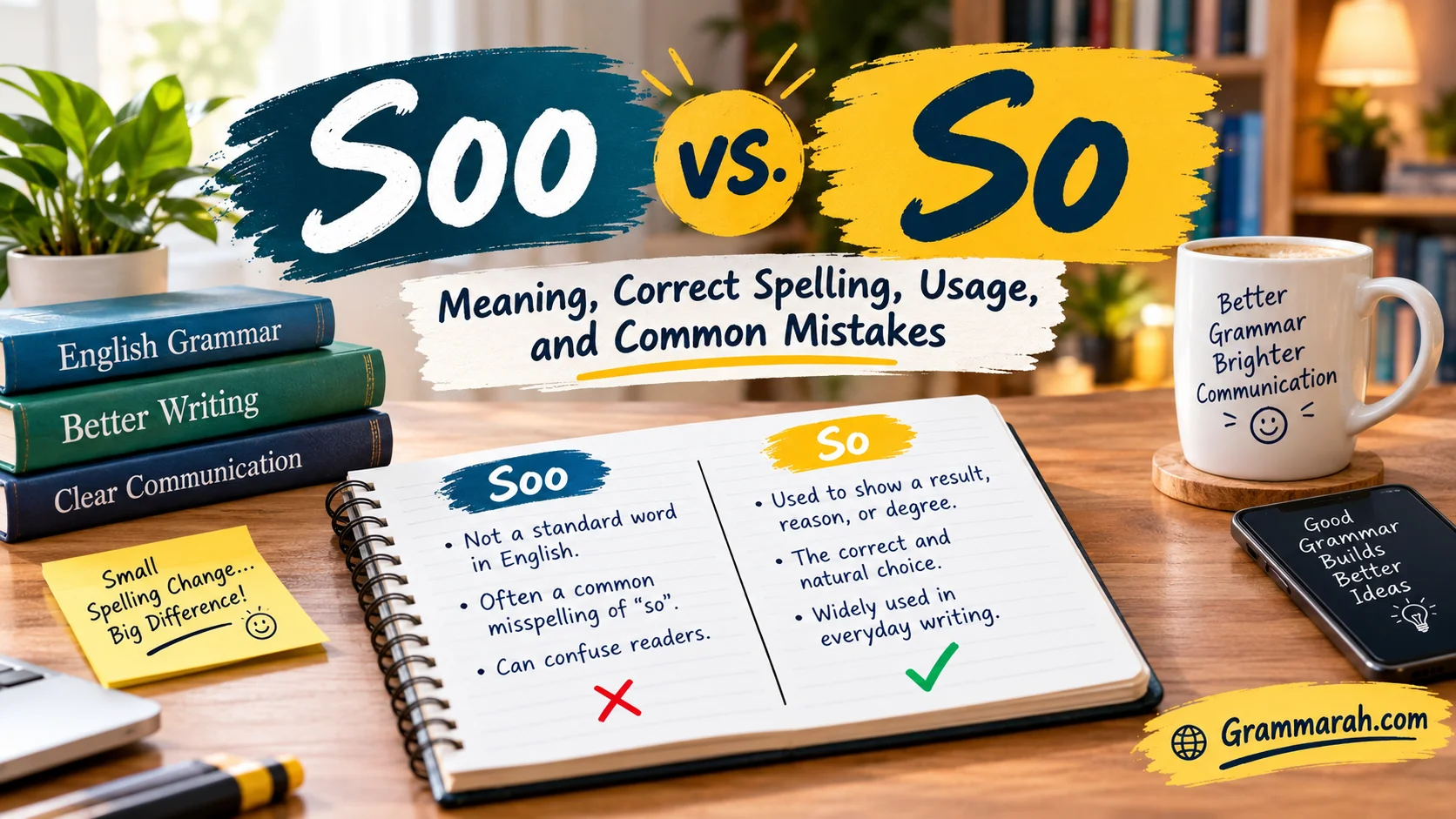

Soo vs So may look like a tiny difference, but that extra o can change the tone, emotion, and style of a message. In standard English, so is the correct spelling, while soo is an informal and stylistic spelling often used in text messages, Instagram captions, comments, and other social media communication. For example, “I’m so happy” follows standard language rules, while “I’m so happy!” adds emphasis and excitement. The second form can feel more expressive, natural, and conversational in casual writing, even though it isn’t standard spelling.
The main rule is simple: use so in formal writing, professional communication, and situations where correct English matters most. Use so only when you deliberately want to show emotion, emphasis, or a playful tone. The extra letter works as a visual emphasis marker, helping people express feelings that would otherwise be harder to show through plain written language. That’s why it can work naturally in a text message such as “That was soo good!” but may look out of place in a formal sentence. Context matters because everyday digital language often allows spelling variation that wouldn’t belong in formal English.
From a practical usage perspective, it isn’t always a simple mistake. Sometimes it’s a deliberate stylistic choice that helps capture emotion and conversational sound. The key is knowing when that choice fits. If you’re writing an Instagram caption, chatting with friends, or sending casual messages, “soo” can make your words feel warmer and more expressive. If you’re preparing an article, application, report, or other formal text, stick with it. This distinction gives you clear guidance without treating real-world language use as a rigid set of rules.
Quick Answer: Soo vs So
So is the correct standard-English spelling. Soo is generally an informal, nonstandard spelling used to stretch so for emphasis, emotion, or a playful tone.
| Word | Standard English? | Main Use | Typical Context |
| So | Yes | Degree, result, emphasis, similarity | Formal and informal writing |
| Soo | No, not as a variant of “so” | Emotional emphasis | Texting and social media |
| Sooo | No | Stronger emphasis | Very informal writing |
Simple rule: Use so for standard English. Use soo only when you deliberately want an informal, expressive effect.
What’s the Difference Between “Soo” vs “So”?
The main difference is standard usage versus expressive spelling.
So is an established English word with several grammatical functions. It can work as an adverb, conjunction, and other parts of speech depending on the sentence.
Soo, when used to mean an exaggerated so, isn’t normally a separate standard-English spelling. Writers often add another o to make the word look stretched.
For example:
- I’m so tired. — Standard English
- I’m so tired. — Informal emphasis
- I’m sooo tired. — Stronger informal emphasis
The meaning stays essentially the same. The extra letters mainly change the tone.
What Does “So” Mean?
So is a short word with many different uses in English.
It can express degree, consequence, similarity, manner, or emphasis depending on the sentence.
For example:
- The coffee is so hot. — Shows degree.
- She runs so quickly. — Shows degree or manner.
- It was raining, so we stayed home. — Shows a result.
- I think so. — Refers to something previously mentioned.
- So did I. — Shows similarity.
Because it has several grammatical roles, context plays an important part in understanding it.
How to Use “So” Correctly
Use “so” to express degree, emphasize an adjective or adverb, connect a cause with its result, or avoid repeating information.
“So” as an Adverb
One of the most common uses of so is to show a high degree.
Examples include:
- The test was so difficult.
- She speaks so clearly.
- That movie was so good.
- The room was so quiet.
In these examples, it strengthens the adjective or adverb that follows it.
You can also use so with words such as much, many, little, and few.
- so much work
- so many people
- so little time
- so few opportunities
“So” as a Conjunction
So can connect two ideas when the second idea expresses a result.
For example:
I was exhausted, so I went to bed early.
The first part explains the situation. The second part gives the result.
More examples include:
- The store was closed, so we went home.
- She missed the bus, so she called a taxi.
- It started raining, so we canceled the picnic.
- He studied hard, so he passed the exam.
This is a standard and extremely common use of so.
“So” as an Intensifier
You can use so to add emotional or descriptive emphasis.
For example:
That movie was so funny.
Here, it strengthens the funny.
You can also say:
- She was so excited.
- That was so beautiful.
- I’m so glad you came.
- The food was so delicious.
This use helps explain why people sometimes write soo online. They take an already emphatic word and stretch its spelling to make the emotion more noticeable.
“So” as a Substitute for Repeated Information
So can also prevent unnecessary repetition.
For example:
“Do you think she’ll come?”
“I hope so.”
Here, it represents the idea that she will come.
Other examples include:
- I think so.
- I believe so.
- I suppose so.
- I guess so.
- I hope so.
This makes conversation shorter and more natural.
“So” to Show Similarity
English also uses so in expressions such as:
- So do I.
- So am I.
- So did they.
- So have we.
For example:
“I love old movies.”
“So do I.”
The second speaker means “I love old movies too.”
Common and Correct Uses of “So”
“So” commonly expresses degree, emphasizes an idea, connects cause and effect, and refers back to information already mentioned.
Showing Cause and Effect
Use so to connect a cause with its result.
The road was flooded, so we took another route.
Other examples:
- I was hungry, so I made lunch.
- She felt sick, so she went home.
- The alarm rang, so everyone left.
The basic structure is:
Cause → so → Result
Showing Degree or Emphasis
Use so before adjectives and adverbs.
Examples include:
- so beautiful
- so difficult
- so quickly
- so carefully
- so expensive
You can also use so much and so many:
- so much information
- so many questions
- so little time
- so few choices
Linking Ideas Naturally
In conversation, you can also introduce a new point or move a discussion forward.
For example:
So, what happened next?
Or:
So, let’s look at the next example.
Here, so doesn’t necessarily express a direct cause and effect. Instead, it helps organize the conversation.
Everyday Examples of “So” in Context
People use “so” in everyday English to show degree, connect ideas, express results, or emphasize feelings.
Spoken English
So appears constantly in everyday conversation.
So, what are we doing tomorrow?
I was so tired after work.
It was raining, so we stayed home.
Oh, so that’s why you called!
The word can emphasize an idea, connect events, or introduce a new topic.
Written English
In ordinary writing, it works naturally.
The company reduced costs, so profits increased.
The instructions were so clear that everyone finished quickly.
I didn’t know the answer, so I checked the book.
Professional Writing
Professional writing also uses so, particularly when the tone is straightforward and conversational.
For example:
The data was incomplete, so the analysis was delayed.
In more formal writing, you might choose therefore or as a result, depending on the sentence.
The important point is that it itself isn’t unprofessional. The problem comes from using an intentionally stretched spelling such as soo in a formal context.
Is “Soo” a Real Word?
If the question is whether soo is the standard spelling of the ordinary English word so, the answer is no.
The standard form is so.
However, you shouldn’t assume that every instance of soo represents an accidental typo. Online communication often uses altered spellings to express emotion, humor, exaggeration, or personality.
Consider the difference:
I’m so tired!
I’m sooo tired!
The second version visually stretches the word. It suggests that the speaker feels extremely tired.
Emotional Emphasis
People often use soot to make their writing feel more expressive.
For example:
I’m soo happy right now!
The additional o doesn’t create a new dictionary meaning. Instead, it gives the sentence a more excited and informal tone.
Similar patterns appear in expressions such as:
- nooo
- yesss
- pleeease
- whyyy
- sooo
These spellings imitate the way people might stretch sounds when speaking.
Why Do People Write “Soo” Instead of “So”?
People write “soo” instead of “so” to add emotional emphasis, exaggeration, or a playful tone in informal communication.
To Stretch the Sound for Emphasis
When people speak, they can lengthen a vowel to express emotion.
For example:
“I’m sooooo excited!”
Online, writers can’t use their voice to create that effect. They sometimes reproduce it visually by adding letters.
That’s why soo, sooo, and soooo appear in casual writing.
To Express Emotion or Excitement
The spelling can communicate:
- Excitement
- Surprise
- Frustration
- Affection
- Humor
- Exaggeration
- Playfulness
For example:
“That was sooo cute!”
The extra letters make the statement feel more energetic.
Influence of Digital Culture
Texting and social media have created communication styles that are much more flexible than traditional formal writing.
People use:
- Repeated letters
- Capitalization
- Emojis
- Abbreviations
- Intentional misspellings
- Extra punctuation
These features can communicate emotions that would otherwise be difficult to hear through text.
Speed and Informality
People also type differently when they aren’t writing for publication.
A quick text doesn’t receive the same editing that a business report does. Casual writing allows more freedom, which is why expressive forms like soo have become common online.
Where Does “Soo” Actually Appear?
You’ll most often see so in highly informal communication.
Common examples include:
- Text messages
- Social media posts
- Online comments
- Direct messages
- Casual captions
- Group chats
- Informal dialogue
- Humorous writing
For example:
“I’m soo ready for the weekend!”
The writer is usually making a deliberate stylistic choice.
Conclusion
Soo vs So is a small spelling difference with a clear purpose. So is the standard and correct form for formal writing, professional communication, and everyday English. Soo is an informal, stylistic variation that people often use in text messages, Instagram captions, comments, and social media to add emotion, emphasis, or a more playful tone. If you want to follow standard English rules, choose so. If you’re writing casually and want to make your feelings sound stronger, so can work as a deliberate stylistic choice.
FAQs
Q1. Is “soo” correct English?
Soo isn’t the standard spelling of so. It’s mainly an informal spelling used online to express emphasis, emotion, or excitement.
Q2. Is “so” better than “soo”?
Yes, when you’re following standard English. Use so in formal writing, schoolwork, professional communication, and other situations where standard spelling matters.
Q3. Why do people write “soo” in text messages?
People use soo to make a word feel more emotional or expressive. The extra o can suggest excitement, enthusiasm, exaggeration, or a playful tone.
Q4. Can I use “soo” in an Instagram caption?
Yes. Soo can work well in casual Instagram captions, comments, and messages when you want to add personality or emphasis. It’s a stylistic choice rather than standard spelling.
Q5. Should I write “I’m so happy” or “I’m so happy”?
Use “I’m so happy” when you want standard English. Use “I’m so happy!” in casual writing when you intentionally want stronger emotion or a more expressive tone.