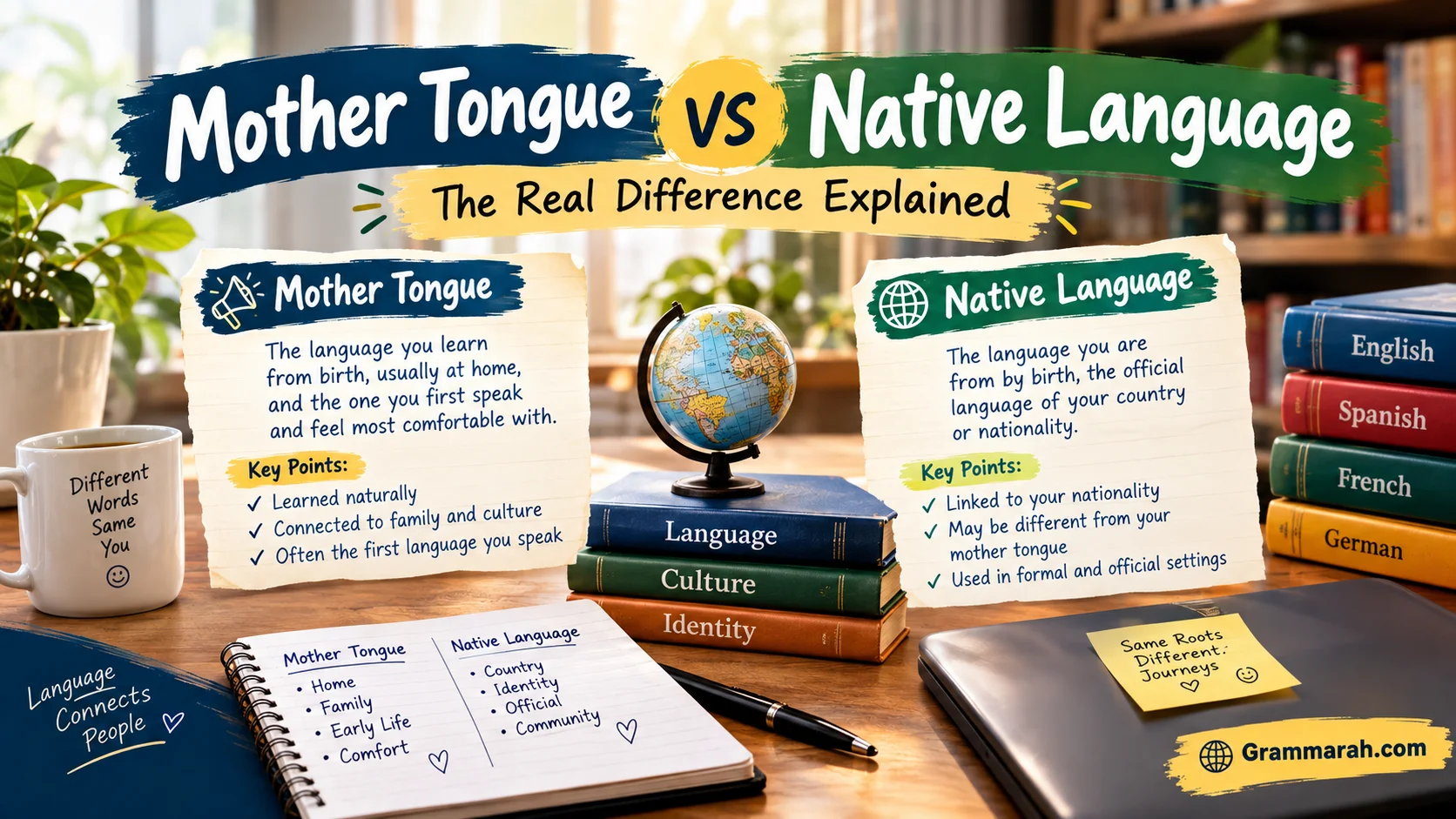

The terms Mother Tongue vs Native Language can overlap, but they may describe different parts of a person’s language background and language identity in everyday use. Your first language often connects to family, childhood, and early language acquisition, while later language learning can change your language proficiency and language use. In a bilingual or multilingual home, for example, you may grow up with more than one language and develop different levels of language dominance. Your family environment, language experience, and cultural identity can therefore shape how you understand each term.
The choice between these language labels also depends on terminology and context. Mother tongue, native language, and first language can have similar meaning, yet their use may reflect different aspects of language history and acquisition history. A person may have learned the first language but use another more frequently later in life. That change can influence current language ability, current proficiency, and everyday communication without removing the person’s earlier linguistic identity. This is why a simple dictionary definition doesn’t always capture the full picture.
A closer comparison becomes useful when you consider language status, native speaker identity, cultural belonging, and family connection. There may be considerable overlap between the terms, especially when someone’s home language remains their strongest language throughout life. However, language use, social experience, and personal circumstances can create a meaningful distinction. Looking at the linguistic context, language context, and personal history helps explain why people may choose one term over another when describing their relationship with a language.
Quick Answer: Mother Tongue vs Native Language
Mother tongue usually refers to a language associated with a person’s early childhood, family, home, or cultural background. Native language generally describes a language acquired naturally from early childhood rather than learned later as an additional language.
First language (L1) is often the most precise term in linguistics because it focuses on acquisition. However, even L1 can include more than one language when a child acquires two languages from the beginning. A bilingual child can therefore have two first languages rather than one.
Here is the simplest way to separate the ideas:
| Term | Main Focus | Typical Meaning |
| Mother tongue | Family, upbringing, identity | Language associated with early childhood or home |
| Native language | Natural early acquisition | Language acquired naturally during childhood |
| First language (L1) | Acquisition order | Language or languages acquired first |
| Home language | Household use | Language learned or used in the home |
| Heritage language | Family and cultural connection | Language connected to family heritage, often with varying proficiency |
| Dominant language | Current ability or use | Language a person currently uses most effectively or frequently |
The important point is that these categories can overlap without being identical.
What Does Mother Tongue Mean?
The phrase mother tongue has a broader meaning than its literal wording suggests. It doesn’t necessarily mean “the language spoken by your mother.” Instead, it commonly points toward a language learned during childhood, particularly within the family or home environment.
However, the phrase can also carry a strong cultural and emotional dimension. For some people, mother tongue means the language connected to parents, grandparents, childhood memories, traditions, and family identity.
That range matters because a person’s mother tongue doesn’t always match their strongest language.
Consider someone who grew up speaking Spanish with family but later moved to an English-speaking country. English might eventually become the person’s strongest language at school and work. Spanish can still remain their mother tongue in a family or cultural sense.
Mother Tongue and Early Childhood
Early exposure plays a major role in how people understand the term.
A child might acquire a language naturally through:
- Parents
- Grandparents
- Siblings
- Caregivers
- Neighbors
- Friends
- Community members
- Everyday interaction
The language doesn’t have to be formally taught. A child normally develops it through repeated exposure, interaction, listening, imitation, and participation in daily life.
That’s one reason the idea of a mother tongue is closely tied to childhood environments.
Mother Tongue Doesn’t Always Mean Strongest Language
This is one of the most important distinctions.
Imagine a child who speaks Urdu at home but attends an English-medium school from age four. By adulthood, that person may read, write, study, and work primarily in English while still considering Urdu their mother tongue.
The language learned early and the language currently used most don’t have to be the same.
Language dominance can shift as a person’s surroundings change. School, migration, friendships, employment, marriage, media, and social networks can all affect which language becomes easier or more frequent.
What Does Native Language Mean?
Native language generally refers to a language acquired naturally during early childhood. Unlike a language learned later through formal classes, a native language develops through early and sustained exposure.
The term usually describes how and when a language was acquired, rather than simply identifying someone’s nationality.
For example, a child born in Japan to English-speaking parents could grow up speaking English at home and Japanese in the surrounding community. Being born in Japan doesn’t automatically make Japanese the child’s native language.
Native Language and Natural Acquisition
Native-language development typically happens through extensive exposure rather than deliberate memorization.
A young child doesn’t normally study grammar rules before learning how to form sentences. Instead, the child hears language repeatedly, recognizes patterns, responds to others, and gradually develops increasingly complex communication skills.
This makes native language closely connected with natural childhood acquisition.
However, the word native becomes more complicated when someone grows up with several languages. A bilingual child exposed to two languages from infancy may reasonably be described as having two native languages.
Native Language Doesn’t Mean “Language of Your Country”
Nationality and native-language status are separate concepts.
A person can be:
- Born in one country
- Raised in another
- Exposed to several languages
- Educated in a third language
- Most proficient in a language different from their family’s language
For that reason, asking someone for their native language isn’t always the same as asking for their nationality.
A person’s passport tells you where they belong legally. It doesn’t automatically tell you which language they acquired naturally as a child.
Where Does First Language (L1) Fit?
First language, often abbreviated L1, is especially useful when discussing language acquisition.
The term focuses on the language or languages acquired first rather than automatically emphasizing nationality, culture, family identity, or current dominance.
For example:
A child grows up hearing Mandarin and English from infancy.
In this situation, both languages can function as first languages. Calling one language the only L1 simply because it is spoken more frequently later can miss the child’s actual acquisition history.
L1 Is Not Always the Strongest Language
This distinction is crucial.
L1 answers an acquisition question.
It doesn’t necessarily answer:
- Which language do you speak best?
- Which language do you use most?
- Which language do you write best?
- Which language do you use professionally?
- Which language feels most comfortable today?
Those questions concern proficiency, frequency, dominance, or personal preference.
That’s why someone can have an L1 that isn’t their current dominant language.
A person may have learned Arabic first, become highly educated in English, and eventually use English more often in professional life. Their acquisition history and present-day language habits are different parts of the same story.
Mother Tongue vs Native Language: Key Differences
Although these expressions overlap, they emphasize different ideas.
| Feature | Mother Tongue | Native Language | First Language |
| Early childhood | Usually important | Central | Central |
| Family connection | Often strong | Not required | Not required |
| Cultural identity | Often important | Sometimes important | Not necessarily |
| Natural acquisition | Usually implied | Strongly implied | Usually implied |
| Acquisition order | Often implied | Not always the main focus | Main focus |
| Current strongest language | Not necessarily | Not necessarily | Not necessarily |
| Can it include two languages? | Yes, depending on definition | Yes | Yes |
| Academic precision | Moderate | Moderate | Higher |
The biggest mistake is treating these terms as three rigid boxes. Language experience is more fluid than the labels suggest.
Why Mother Tongue Feels More Personal
The phrase mother tongue often carries emotional weight because language is closely connected with childhood, family relationships, traditions, stories, humor, and cultural memory.
Someone may use a language only occasionally yet still feel deeply connected to it.
That can happen when:
- Parents use the language at home.
- Grandparents speak it.
- Family traditions are expressed through it.
- Cultural ceremonies use it.
- Childhood memories are tied to it.
- The language represents family heritage.
- Important expressions exist mainly in that language.
This explains why the mother tongue can remain meaningful even after a person becomes more fluent in another language.
Here is the same conclusion and FAQ section with the key terms bolded throughout.
Conclusion
Mother tongue and native language often refer to the same language, but they aren’t always identical. Your first language, family environment, language acquisition, and language use can influence which term fits best. A person may grow up bilingual or multilingual, learn one language first, and later become more proficient in another. Understanding these differences makes it easier to describe someone’s language background, linguistic identity, and cultural connection accurately.
FAQs
Q1. Is my mother tongue the same as native language?
Not always. Mother tongue usually refers to a language learned during early childhood, while native language can emphasize a person’s natural or native-speaker relationship with a language. In many situations, however, people use the two terms interchangeably.
Q2. Is the first language the same as the mother tongue?
They can be the same, but not necessarily. First language generally means the language acquired first. Someone raised with two languages from infancy may have more than one first language.
Q3 . Can a person have two mother tongues?
Yes. A child raised in a bilingual family may acquire two languages naturally from an early age. Both languages may become important parts of the person’s family life, cultural identity, and communication.
Q4. Can your native language change over time?
Your language abilities and language dominance can change, especially after moving to a different country or spending many years using another language. However, learning another language doesn’t automatically erase the language you acquired first.
Q5. Which term should I use: mother tongue or native language?
Choose the term that best matches your purpose. Mother tongue works well when discussing early family and cultural language experience. Native language can work better when focusing on native-speaker status or language ability. In formal or academic contexts, first language (L1) can provide a more precise description.