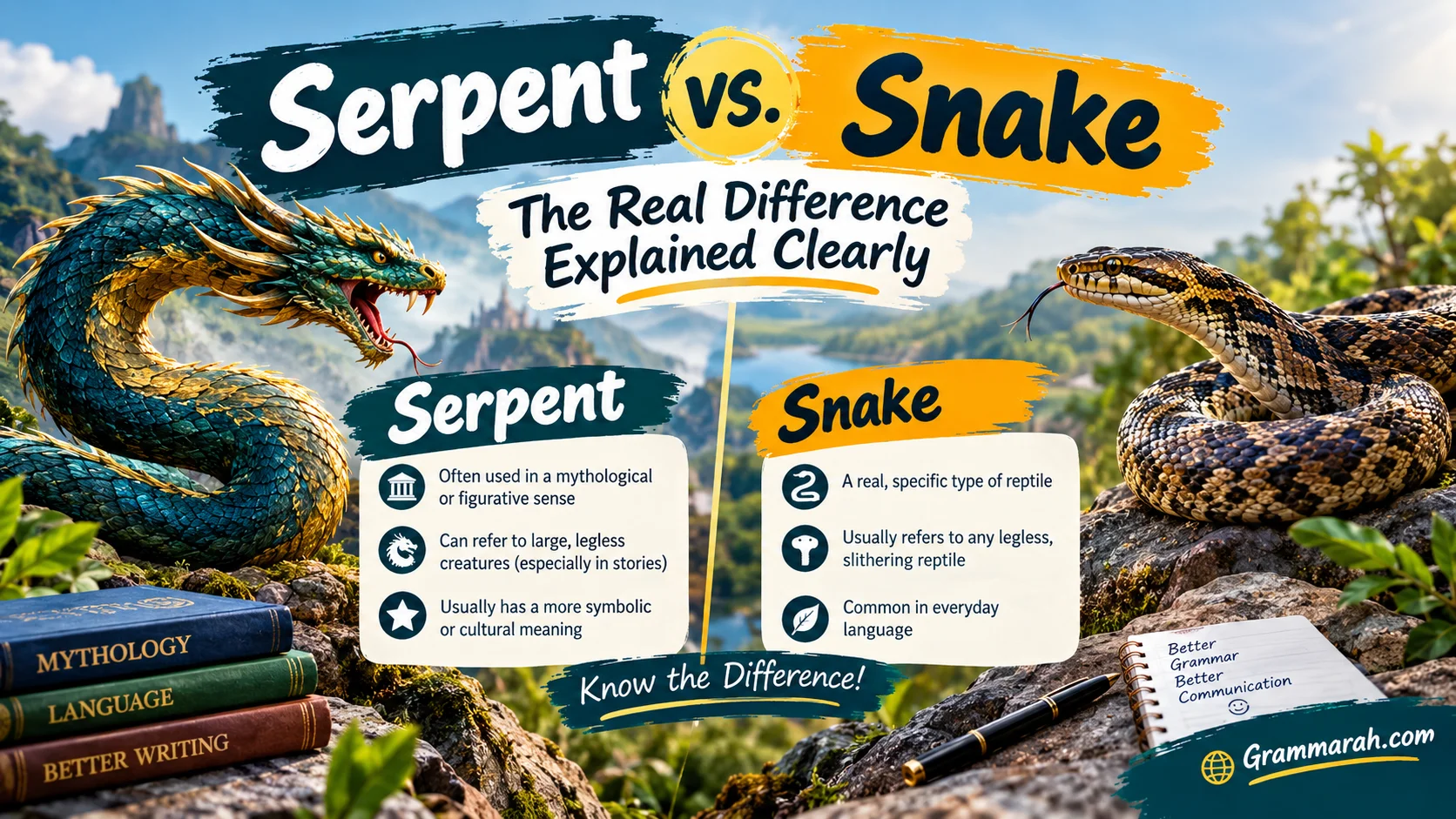

In Serpent vs Snake, the difference usually comes from meaning, tone, and context, because snake sounds ordinary while serpent feels formal or ancient. In everyday English, snake is the common word for a limbless reptile, while serpent often sounds more formal, literary, religious, or mythical. Both words can describe the same animal, so they may be interchangeable in basic usage. However, serpent has deeper historical, cultural, and symbolic associations that can influence how readers understand the word.
The tone changes when you choose serpent instead of snake. Saying “a snake crossed the road” sounds neutral and factual, while “a serpent emerged from the ruins” creates a darker, more dramatic image. This difference comes from religion, mythology, literature, and older forms of language, where serpent often appears as a powerful symbol. From a scientific perspective, however, the distinction matters less because scientific terminology usually relies on precise biological classifications rather than either common term.
When choosing between the two in writing, consider the context, tone, and meaning you want to convey. Use snakes for simple, everyday communication and straightforward descriptions of an animal. Choose serpent when the sentence needs a more ancient, formal, symbolic, religious, or dramatic feeling. The two words can refer to the same creature, but their usage and emotional effect can differ. Understanding this distinction helps you select the word that fits your sentence naturally without making the language sound forced.
Quick Answer: What Is the Difference Between Serpent and Snake?
Snake and serpent can refer to the same animal. Neither word automatically describes a separate type of reptile.
The main difference is how the words are used and what they suggest.
- Snake is the standard modern English word.
- Serpent is a less common word for a snake.
- Snake sounds neutral, direct, and conversational.
- Serpent often sounds literary, formal, archaic, religious, or mythological.
- Snake works well in everyday, educational, journalistic, and scientific writing.
- Serpent often works best when symbolism, history, mythology, or atmosphere matters.
- Neither word automatically means venomous, dangerous, or evil.
| Feature | Snake | Serpent |
| Basic meaning | A snake or limbless reptile | A snake |
| Everyday use | Very common | Less common |
| Tone | Neutral and direct | Literary or elevated |
| Scientific context | Common | Less common as a general term |
| Religious context | Possible | Very common |
| Mythological context | Common | Especially common |
| Symbolic meaning | Context-dependent | Often stronger |
| Archaic feeling | Rare | Possible |
| Best default choice | Yes | Depends on context |
The easiest rule is simple: use snake for ordinary factual communication and serpent when the context calls for literary, historical, religious, or symbolic language.
What Does Snake Mean?
Snake means a long, legless reptile with a flexible body, usually covered in scales and moving by slithering.
Definition of Snake
A snake is a limbless reptile belonging to the group known scientifically as Serpentes. Snakes have elongated bodies covered with scales and appear in an enormous range of shapes, sizes, colors, and habitats.
Some snakes are venomous. Others aren’t.
Some kill prey with venom, while others rely on constriction. Many species are harmless to humans and play important roles in ecosystems by controlling populations of rodents, insects, amphibians, and other animals.
So the word snake tells you what kind of animal you’re dealing with. It doesn’t automatically tell you whether that animal is dangerous.
For example:
The snake disappeared beneath the rocks.
Nothing about this sentence suggests that the animal is venomous. It simply identifies the creature.
How Snake Is Used in Modern English
Snake is the word most English speakers naturally choose when discussing the animal in everyday situations.
You’ll commonly see it in:
- Wildlife articles
- School textbooks
- Nature documentaries
- News reports
- Everyday conversations
- Pet-care information
- Biology discussions
- General descriptions
- Travel writing
For example:
We saw a snake near the trail.
The snake moved slowly through the grass.
Scientists studied the snake’s feeding behavior.
All three sentences sound natural because the snake is familiar and straightforward.
Snake Has Figurative Meanings Too
The word snake doesn’t always refer to an actual reptile.
English speakers sometimes use snakes as a metaphor for someone considered dishonest, treacherous, or untrustworthy.
For example:
I thought he was my friend, but he turned out to be a snake.
The person obviously isn’t a reptile. The word describes his behavior.
English also uses snake to describe something that twists or winds:
The road snakes through the mountains.
Here, snakes works as a verb. It creates a visual comparison between the winding road and the movement of a snake.
This figurative flexibility has made snake a deeply established word in modern English.
What Does Serpent Mean?
Serpent means a snake, especially a large or dangerous one; it can also refer to a snake-like creature in mythology or symbolism.
Definition of Serpent
Serpent generally means snake.
That’s the most important point to remember.
A serpent isn’t automatically a special species, a separate reptile, or a particular kind of venomous animal. In ordinary English, the word can simply refer to a snake.
However, the serpent has a different flavor.
It often appears in language connected with:
- Religion
- Mythology
- Ancient cultures
- Poetry
- Literature
- Fantasy
- Historical writing
- Symbolism
- Dramatic storytelling
That’s why the word can feel heavier than snake, even when both refer to the same creature.
The Historical Background of Serpent
The history of the serpent helps explain its unusual character.
The English word came through French from Latin serpens, which is connected to the Latin verb serpere, meaning to creep or to crawl.
This history also connects with the scientific name Serpentes, the taxonomic group that includes snakes.
That connection is worth remembering because it shows that serpent isn’t an unrelated word for snake. The two concepts have been connected linguistically for centuries.
How Serpent Is Used Today
Modern English still uses serpents, but the setting usually matters.
A writer might choose it when describing:
- An ancient creature
- A mythological being
- A religious symbol
- A legendary monster
- A poetic image
- A supernatural creature
- A powerful or mysterious snake
For example:
A serpent guarded the entrance to the ancient temple.
The word serpent makes the scene feel older and more mysterious.
Compare that with:
A snake guarded the entrance to the ancient temple.
The second sentence is perfectly understandable. It simply feels more ordinary.
Are Serpent vs Snake Scientifically Different?
Scientifically, serpent and snake aren’t different animals; serpent is another word for a snake, while Serpentes is the scientific group that includes snakes.
The Scientific Reality
No. Serpent and snake aren’t two separate biological categories.
The scientific classification Serpentes refers to snakes.
This creates an important distinction between common English vocabulary and scientific taxonomy.
Think of it this way:
- Snake is a common English name.
- Serpent is another English word that can mean snake.
- Serpentes is a scientific taxonomic term.
Confusing these three levels can lead to inaccurate explanations.
Why Science Usually Uses Snake
Scientific writing aims for clarity and consistency.
When scientists discuss snakes generally, snakes are perfectly suitable. When they need greater precision, they can identify the animal by its scientific classification, genus, species, family, or another appropriate taxonomic level.
For example, saying snake tells readers what broad group of animals you’re discussing.
Giving a species name tells them much more.
Using serpent simply to make scientific writing sound sophisticated doesn’t improve accuracy. In fact, it can make the writing less direct.
Can Serpent Appear in Scientific Language?
Yes.
It would be inaccurate to claim that scientists never use the word serpent.
The clearest example is Serpentes, the scientific taxonomic name associated with snakes. The word can also appear in scientific names, common names, historical terminology, and specialized descriptions.
The important point is that serpent isn’t a separate scientific category simply because the word appears in scientific terminology.
Serpent vs Snake in Modern English
In modern English, snake is the common everyday term, while serpent is less common and often sounds more literary, formal, historical, or symbolic.
Snake in Spoken English
In everyday conversation, snakes are overwhelmingly the natural choice.
Imagine someone pointing toward a garden and saying:
There’s a snake over there!
That sounds completely normal.
Now imagine:
There’s a serpent over there!
The second sentence isn’t wrong. It just sounds unusually dramatic unless the speaker has a specific reason for using it.
Maybe they’re telling a fantasy story. Maybe they’re joking. Maybe they’re describing a huge mythical creature.
Without that context, snake sounds more natural.
Serpent in Written English
Serpent becomes more comfortable in certain types of writing.
You’ll encounter it more often in:
- Poetry
- Fiction
- Religious writing
- Mythology
- Historical texts
- Fantasy literature
- Literary analysis
Writers can use the word to give a description extra texture.
For example:
The serpent coiled beneath the ancient stone altar.
The word fits naturally with ancient, stone altar, and the mysterious setting.
Why Register Matters
Every word has a level of formality or familiarity.
For example:
- Kid sounds casual.
- The child sounds neutral.
- Youth can sound more formal or literary.
The same principle applies to snakes and serpents.
They overlap in meaning, but they don’t always belong to the same stylistic register.
Serpent vs Snake: Tone and Connotation
Snake sounds neutral and everyday, while serpent often feels more literary, ancient, mysterious, or symbolic.
Snake Is Usually Neutral
When you say snake, you’re usually giving readers a straightforward description.
The snake moved across the road.
The sentence doesn’t automatically suggest mythology, evil, magic, or ancient symbolism.
That’s one reason snake is such a useful word.
It gets the job done without creating an unnecessary atmosphere.
Serpent Often Sounds Symbolic
Serpent, on the other hand, can bring additional associations to the reader’s mind.
Depending on the context, those associations might include:
- Mystery
- Danger
- Deception
- Ancient power
- Wisdom
- Transformation
- Renewal
- Evil
- Supernatural forces
These meanings aren’t built into every use of the word.
Context decides what the reader takes from it.
A serpent in a religious story may represent temptation. A serpent in another cultural tradition may represent healing or renewal.
A Simple Example of the Difference
Compare:
A snake appeared beside the tree.
with:
A serpent appeared beside the ancient tree.
The animal could be identical.
The reader’s emotional response, however, may differ.
The first sentence sounds like a nature observation.
The second sounds like the beginning of a legend.
That’s the practical heart of the serpent vs snake distinction.
Serpent vs Snake in Religion
In religion, serpent often carries deeper symbolic meanings related to temptation, evil, wisdom, healing, or transformation, depending on the tradition.
The Serpent in Biblical Tradition
Few associations have influenced the English word serpent more strongly than biblical language.
In the Book of Genesis, a serpent appears in the account involving Adam and Eve. Traditional English religious language has long used a serpent for this figure.
That history helped give serpent a powerful symbolic association with:
- Temptation
- Deception
- Sin
- Evil
Because of this tradition, serpent can immediately sound religious or theological to English readers.
Compare:
The snake tempted Eve.
with:
The serpent tempted Eve.
The second version sounds much closer to traditional biblical storytelling.
Serpent Symbolism Isn’t Always Negative
However, reducing every religious serpent to evil would be misleading.
Serpent imagery appears in many traditions, and its meaning varies.
Across different cultures, serpents have been associated with:
- Healing
- Wisdom
- Protection
- Fertility
- Renewal
- Death
- Rebirth
- Divine power
The ability of many snakes to shed their skin has also contributed to associations with renewal and transformation.
So when you encounter serpent symbolism, always examine the specific cultural and religious context.
Conclusion
The main difference between serpent and snake lies in tone, context, and usage, rather than the animal itself. Snake is the natural choice for everyday English, while serpent often sounds more formal, ancient, literary, religious, or symbolic. Although both words can describe the same reptile, your choice can change the feeling of a sentence. For clear, ordinary communication, choose snake. When you want a darker, dramatic, mythical, or historical effect, serpent may be the better fit.
FAQs
Q1. Is a serpent the same as a snake?
Yes. In many contexts, serpent and snake can refer to the same animal. The main difference is their tone and usage.
Q2. Is snake more common than serpent?
Yes. Snake is much more common in everyday English, while serpent appears more often in literary, religious, historical, and symbolic contexts.
Q3. Is serpent a formal word for snake?
Generally, yes. Serpent can sound more formal, poetic, or old-fashioned than snake, depending on the sentence and context.
Q4. Why is serpent used in religious texts?
Serpent often appears in religious traditions because of its long historical and symbolic associations. It can represent ideas such as temptation, danger, wisdom, or transformation, depending on the tradition.
Q5. Should I use serpent or snake in writing?
Use snakes for clear, everyday descriptions. Choose serpent when you want a more dramatic, ancient, literary, mythical, or symbolic tone.